Thursday, August 27, 2026

Veterinary Front-Desk Training That Sticks: The One-Poster Practice Loop

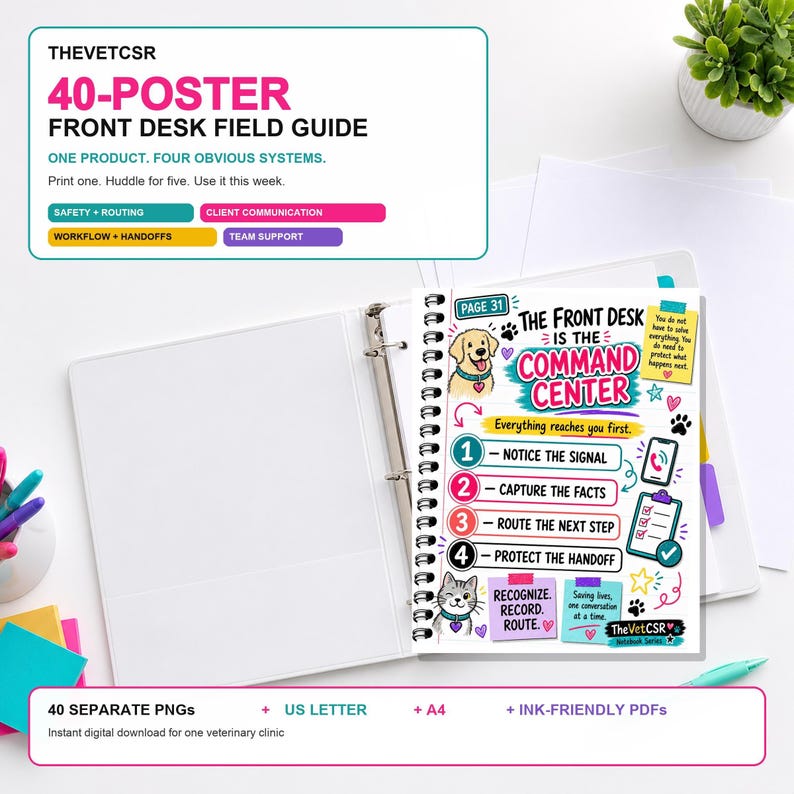
TheVetCSR 40-poster veterinary front-desk field guide organized into safety and routing, client communication, workflow and handoffs, and team support.

A poster on the wall is not automatically training.

It becomes useful when the team stops long enough to connect the message to one real problem, one clinic-approved response, and one behavior they can try during the next shift.

That does not require a seminar. It can start with five focused minutes.

AAHA has emphasized that communication training should include the whole veterinary team, and that clear communication between team members helps people stay aware of what is happening with clients and patients. A separate AAHA discussion of team roles points to quick verbal rounds, timely alerts, and detailed records as practical ways to keep information moving.

The lesson is simple: a visual reminder works best when it supports a shared conversation and a defined workflow.

This is the implementation companion to Veterinary Front-Desk Call Training: A Recognize, Record, Route System. That article focuses on the content of a safer call handoff. This one focuses on how to practice one communication or workflow behavior until it becomes easier to use.

Why one poster is enough for today

Forty topics at once become background noise. One relevant topic can become a decision.

Start with the pressure point your front desk is actually experiencing:

  • Safety and routing: Are urgent concerns reaching the right person through the clinic's approved process?
  • Client communication: Is the team struggling with estimates, fully booked days, callbacks, or boundaries?
  • Workflow and handoffs: Are details getting lost between the phone, lobby, treatment area, and medical record?
  • Team support: Is a difficult interaction still affecting the next call or the rest of the shift?

Choose the system that fits today's problem. Then choose one poster from that system. The goal is not to cover the entire library. The goal is to make one expectation clearer.

The five-minute huddle

The Agency for Healthcare Research and Quality's TeamSTEPPS materials distinguish between a brief that establishes goals, roles, and a plan, and a huddle that helps a team update situation awareness or adjust a plan when something changes. Those tools were built for healthcare teams, not specifically as a veterinary-poster method. The structure still offers a useful principle for veterinary practices: keep the conversation focused, make the next step explicit, and give team members a chance to speak.

Here is a simple way to use one front-desk poster without turning it into another meeting that should have been an email.

Minute 1: Name the problem

Show the poster and ask:

Where does this issue show up in our clinic?

Use a real workflow pattern, not client names or identifying case details. Examples might include incomplete callback messages, unclear ownership of the next step, inconsistent explanations, or a handoff that disappears between teams.

Minute 2: Define the clinic boundary

Ask:

What does our current protocol require, and who owns the decision?

This is especially important when the topic touches safety, urgency, medication, diagnosis, treatment, or emergency direction. A general training poster cannot replace clinic-specific instructions or clinical judgment.

Minute 3: Agree on one behavior

Turn the idea into something visible and repeatable.

Examples:

  • repeat the callback number before ending the call;
  • name the person or queue receiving the handoff;
  • document the client's own words before adding interpretation;
  • tell the client what the next step is without promising an outcome or response time the team cannot guarantee;
  • pause after a difficult interaction before answering the next call.

Pick one. If the huddle creates six new rules, it probably did not create clarity.

Minute 4: Test the wording

Ask one person to say the phrase they would actually use.

The wording should sound human, fit the clinic's policy, and be clear enough that another team member understands what happens next. If the group cannot say it simply, the process may still be unclear.

Minute 5: Choose the checkpoint

Decide how the team will know whether the idea helped.

The checkpoint can be small:

  • fewer messages returned for missing information;
  • fewer repeated questions about who owns the next step;
  • more consistent callback documentation;
  • one manager check-in after three shifts;
  • one end-of-week question: What became easier, and what is still getting stuck?

Keep the poster visible for the week. Then retain it, revise the clinic process, or rotate to the next issue based on what the team observed.

A poster should support the system, not carry it

Visual tools are useful because they keep an idea available after the conversation ends. They are not a substitute for onboarding, written procedures, supervision, clinical review, or a workplace where people can raise concerns.

The strongest use is modest and practical:

  1. Choose today's problem.
  2. Print one poster.
  3. Discuss it for five minutes.
  4. Confirm the clinic-approved behavior.
  5. Use it for a week.
  6. Review what changed.

That is enough to turn wall art into a working prompt.

Front desk. Big impact.

The veterinary receptionist is often the first and last person a client encounters at the hospital. The AVMA's overview of the veterinary healthcare team recognizes client service representatives as team members whose work requires communication, multitasking, and professionalism under stress.

The front desk does not need more vague reminders to "communicate better." It needs usable language, clear ownership, safe boundaries, and a way to practice one improvement at a time.

Want a ready-to-use visual library for these conversations? The TheVetCSR 40-Poster Veterinary Front Desk Field Guide organizes 40 printable posters into Safety & Routing, Client Communication, Workflow & Handoffs, and Team Support. The instant digital download includes separate high-resolution PNGs plus US Letter, A4, and ink-friendly 40-page PDFs.

Use one poster at a time. Adapt every educational prompt to your hospital's current protocols.

Sources

Scope note: This article is educational. It does not provide veterinary medical advice or replace diagnosis, treatment, supervision, emergency direction, applicable law, or your clinic's current protocols.

Friday, August 21, 2026

Veterinary Front-Desk Call Training: A Recognize, Record, Route System

The veterinary receptionist who answers the phone is not “just taking a message.” She is turning a worried person’s story into information the medical team can actually use.

That does not mean diagnosing. It means recognizing what matters, recording it clearly, and routing it through the clinic’s approved process.

AAHA describes receptionists and client-service coordinators as an owner’s frequent first interaction with the practice. Its guidance also emphasizes communication resources, telephone-triage skills, and established protocols for nonclinical staff. In AAHA’s standardized workflow example, the CSR gathers the initial reason for the visit and historical information before clinical team members perform medical assessment and triage.

That division matters. A strong front desk does not replace the technician or veterinarian. It gives them a cleaner starting point.

Why “take a message” is not a complete system

A note can contain many words and still fail the handoff.

“Owner worried. Please call” leaves the next person rebuilding the entire conversation. “Dog acting weird” records the caller’s conclusion without preserving what they actually observed. A name and phone number may identify the caller, but they do not explain why the case entered the workflow or what the owner was told to do next.

The problem is not that the receptionist did not care. Usually, the problem is that the clinic never defined what a complete message looks like.

AAHA’s workflow guidance supports using standardized processes for triage calls, follow-up calls, returning client calls, and other recurring communication. A standard does not turn people into robots. It lowers the amount of important information that has to survive on memory alone.

The three-part front-desk job

1. Recognize

Listen for information that changes the next step under your clinic’s protocol.

Start with the owner’s own observations. What changed? When did it begin? What is happening right now? Has the pet already been evaluated or treated? What has the owner already tried? Which details does your hospital require for this type of call?

Good follow-up questions help the caller tell a clearer story. They do not turn the CSR into a remote diagnostician. AAHA’s triage-training guidance makes the same distinction: the purpose of triage is to determine how, when, and where a patient should receive attention—not to name the condition from the phone description.

2. Record

Write what the caller reports, not what you assume it means.

A useful call record usually includes:

  • the caller’s name and best callback number;
  • the patient’s name and signalment when required by clinic policy;
  • the concern in the caller’s own concrete language;
  • the timeline and meaningful changes;
  • relevant information requested by the clinic’s approved script;
  • who received or is expected to receive the handoff;
  • what the caller was told about the next step.

Use observable language. “Owner reports three vomiting episodes since 6 a.m.” is more useful than “possible stomach bug.” “Cat has entered the litter box repeatedly; owner has not seen urine” preserves the report without declaring a diagnosis.

When a detail is unknown, write “unknown” or “owner unsure.” A visible gap is safer than a confident guess.

3. Route

Move the information to the right person through the right channel within the timeframe defined by the practice.

Routing may mean scheduling, placing the caller on hold for a trained team member, sending a message to the assigned clinical queue, directing the owner to an emergency service under standing instructions, or escalating to a manager. The correct route belongs to the clinic—not to a generic internet script.

Close the loop whenever possible. Confirm who owns the next step, repeat what the caller should expect, and document the handoff. A message is not complete merely because it left the CSR’s screen.

Build training around the calls your clinic actually receives

AAHA’s triage-training article recommends starting with the questions clients ask most often, then developing material with the practice’s veterinarians. That is a practical way to build a usable system:

  1. Pull a list of common call types from staff experience and de-identified workflow data.
  2. Ask the medical team what information changes scheduling or escalation for each type.
  3. Write clinic-approved question sets and routing boundaries.
  4. Practice with realistic call scenarios.
  5. Test understanding instead of assuming one training meeting was enough.
  6. Review missed handoffs and repeated callbacks as process data, not automatic proof of individual failure.

The goal is consistent judgment inside a defined scope.

A five-minute huddle for tomorrow

Choose one common call type. Ask the team:

  • What must the CSR recognize?
  • What exact facts must be recorded?
  • Who owns the route?
  • What should the caller hear before the call ends?
  • Where will the completed handoff be visible?

If five team members give five different answers, that is not a receptionist problem. It is a workflow-design problem—and now you know where to start.

The front desk is a clinical communication gateway

Clear communication between the pet owner and the whole veterinary team supports continuity. Consistent systems also help CSRs work confidently without drifting beyond their role.

Recognize. Record. Route. Do not diagnose.

That is not “just answering phones.” It is disciplined communication work at the point where the client’s story first enters the hospital.

Want a printable system you can use at the desk? The 26-page TheVetCSR Veterinary Receptionist Field Notebook brings together call scripts, front-desk workflow prompts, quick-reference pages, and practical support for real clinic shifts. It is an instant digital download; always adapt educational tools to your hospital’s current protocols.

Related reading: When a Dog Is Trying to Vomit but Nothing Comes Up: The GDV Call the Front Desk Must Move.


Keep exploring TheVetCSR: Etsy printable tools · Facebook community · Pinterest resources

Sources

Scope note: This article is educational and does not provide veterinary medical advice. Follow veterinarian direction, applicable law, and your clinic’s current protocols.

Monday, August 17, 2026

Strong Contractions, No Puppy? A Veterinary Front-Desk Guide to Difficult Labor Calls

The client usually does not call and say, “I think my dog has dystocia.”

She says, “My dog is pushing, but no puppy is coming.” Or, “She had one puppy and now nothing is happening.” Or the sentence that changes the whole call: “I can see something, but it looks stuck.”

That is where a trained veterinary front desk matters. We do not have to name the cause. We do have to hear the risk, record the labor timeline, and move the call to the medical team without burying it in a routine callback queue.

What difficult labor can sound like on the phone

Dystocia is the medical term for a difficult birth or the inability to deliver without assistance. It can happen because the uterus is not contracting effectively, the birth canal is obstructed, a puppy is oversized or positioned abnormally, the mother is exhausted, or for another reason that cannot be determined by phone.

The veterinary receptionist may hear:

  • “She has been pushing hard and nothing is coming.”
  • “A sac is showing, but there is no puppy.”
  • “I think a puppy is stuck.”
  • “She delivered one, but it has been a long time.”
  • “There is green discharge and no puppy yet.”
  • “She looks exhausted, painful, sick, or weak.”

These phrases are not a diagnosis. They are a reason to stop treating the call like a scheduling question.

Why the labor timeline matters

Cornell University College of Veterinary Medicine describes strong contractions without a puppy, fetal membranes protruding without delivery, abnormal discharge or heavy bleeding, long gaps without progress, and an ill or exhausted mother as reasons to call a veterinarian immediately.

The Merck Veterinary Manual explains that normal and abnormal timing depends on the stage of labor, strength of contractions, interval between deliveries, and the condition of the mother and fetuses. Merck’s emergency-triage reference lists dystocia among complaints that need stat veterinary evaluation.

You may notice that professional sources use more than one time threshold. That is not a problem the CSR should solve by debating minutes with a frightened caller. Different thresholds describe different clinical situations. The safe front-desk move is to document the timeline accurately and escalate under clinic protocol.

The five details worth capturing

1. How long has she been actively pushing?

Separate visible, active abdominal pushing from earlier nesting, panting, restlessness, or other stage-one labor behavior as best the caller can describe it. Record the caller’s words and the approximate start time. Do not convert an uncertain description into a clinical conclusion.

2. Have any puppies been born?

If yes, record how many and when the most recent puppy was delivered. The clinical team may also ask about the expected litter, prior imaging, pregnancy dates, previous dystocia, or a planned C-section. Capture what the caller knows; do not guess what remains.

3. Is anything visible?

Record whether the caller sees a puppy, part of a puppy, or a fluid-filled sac at the vulva and how long it has been visible. Do not instruct the caller to pull, manipulate, or examine internally. That direction belongs to the veterinarian.

4. What discharge or bleeding is the caller seeing?

Record the caller’s description of color, odor, amount, and timing. Green or dark discharge before a puppy, foul-smelling discharge, or heavy bleeding can be concerning. Do not ask the CSR—or the caller—to decide what is normal from a color chart.

5. How is the mother doing right now?

Capture weakness, collapse, severe pain, exhaustion, vomiting, fever if already measured, abnormal breathing, or a major change in responsiveness. Also record the current location and best callback number so the handoff does not lose the person who needs direction.

A calm script for the veterinary receptionist

“I’m moving this to the medical team now. Please stay with me while I record the labor timeline.”

It is short on purpose. It tells the client that the call is moving, gives the CSR room to collect the essential facts, and avoids promising a diagnosis or outcome.

If the clinic’s protocol requires a different script or immediate transfer, use that. The poster is a memory aid, not a substitute for hospital policy.

What the front desk should not do

  • Do not tell the caller to wait for a universal cutoff when a concerning pattern is already present.
  • Do not diagnose uterine inertia, obstruction, fetal distress, or normal labor by phone.
  • Do not coach the caller to pull a puppy, perform an internal examination, or give calcium, oxytocin, or another medication.
  • Do not promise that the mother or puppies are stable because one reassuring detail is present.
  • Do not choose treatment or transport instructions independently of the receiving medical team.

The pet-owner takeaway

If a dog in labor is pushing strongly without producing a puppy, a puppy or sac is visible without progress, there is abnormal discharge or heavy bleeding, a long gap has passed without progress, or the mother appears ill, painful, weak, or exhausted, contact a veterinarian immediately. Follow the receiving veterinary team’s instructions. Do not attempt medication or manual delivery unless a veterinarian who knows the case specifically directs it.

The front-desk takeaway

The goal is not to prove dystocia over the phone. The goal is to make the urgency visible.

Recognize. Record. Route. Strong contractions with no puppy belong in a clean clinical handoff—not a routine queue.

Sources

Educational scope: This article supports recognition, documentation, and routing. It does not diagnose difficult labor, coach delivery, or replace veterinarian direction or clinic protocol.

Tuesday, August 11, 2026

When a Dog Is Trying to Vomit but Nothing Comes Up: The GDV Call the Front Desk Must Move

“He keeps trying to throw up, but nothing is coming out.”

That sentence should change the pace of a veterinary front-desk call.

It does not prove a dog has bloat. It does not give the CSR a phone diagnosis. But repeated attempts to vomit with little or nothing produced—especially when the abdomen looks swollen or the dog seems distressed—match warning signs described for gastric dilatation-volvulus, or GDV.

This is where front-desk work becomes patient-safety work: hear the pattern, capture the right details, and move the call.

What GDV means—and why the call cannot sit

GDV occurs when a dog's stomach distends and twists. That twist can trap gas, reduce blood flow, damage stomach tissue, interfere with breathing, and lead to shock.

The Merck Veterinary Manual calls GDV an acute, life-threatening condition requiring immediate medical and surgical intervention. Cornell University College of Veterinary Medicine describes it as a sudden emergency, and the American College of Veterinary Surgeons says it is rapidly progressive and needs immediate medical attention.

The CSR does not need to explain the physiology on the phone. The CSR needs to recognize that the sentence cannot wait behind a routine callback.

Listen for the caller's words, not perfect medical vocabulary

Most clients will not say “nonproductive retching.” They may say:

  • “He keeps trying to puke.”
  • “Nothing comes up except foam.”
  • “Her stomach looks huge.”
  • “He cannot get comfortable.”
  • “She keeps pacing and drooling.”
  • “He looks weak now.”

Those descriptions matter. Professional references list nonproductive retching, abdominal distension, restlessness, drooling, weakness, collapse, and breathing difficulty among possible signs of GDV.

None of those signs confirms the diagnosis. They do justify immediate routing.

The five details that strengthen the handoff

Keep the intake short enough that documentation does not become delay.

1. What is the dog actually doing?

Record the caller's description: retching, dry heaving, vomiting, drooling, pacing, stretching, or unable to settle. Preserve their words when possible.

2. Is anything being produced?

“Trying to vomit” and vomiting are not the same observation. Ask whether food, fluid, foam, saliva, or nothing is coming up. Do not use the answer to rule GDV in or out.

3. Does the abdomen look different?

Ask whether it looks enlarged, tight, or painful. A caller may not be able to tell, and the absence of obvious swelling over the phone does not clear the risk.

4. When did this begin?

Capture onset and whether the signs are becoming more frequent or severe. Merck notes that duration of clinical signs is one factor associated with death, which is why this timestamp belongs in the handoff.

5. What is the dog's status right now?

Record breed or body type, age, approximate weight, current location, callback number, responsiveness, weakness, collapse, and any breathing change. Large, deep-chested dogs are at higher risk, but dogs outside that familiar profile still need the same symptom-led routing.

What not to do at the front desk

Do not diagnose GDV. Do not promise it is indigestion or “just gas.” Do not turn the call into a long home-care interview. Do not delay emergency escalation to finish routine registration.

The cleanest scope is still the TheVetCSR standard:

Recognize. Record. Route.

A script that is clear without creating panic

“Trying to vomit without bringing anything up can be an emergency sign. I am routing this through our emergency protocol now.”

That line does three useful things: names why the pace changed, avoids a diagnosis, and tells the caller what is happening next.

If the clinic's current protocol directs a different script or immediate transfer destination, use that. The poster is a memory aid, not a replacement for policy.

The pet-owner takeaway

If a dog repeatedly tries to vomit but produces little or nothing—particularly with a swollen abdomen, distress, drooling, weakness, collapse, or breathing difficulty—seek immediate veterinary attention. Do not wait for every sign to appear.

The front desk is not “just answering the phone”

The person who hears the first vague sentence may be the person who prevents it from sitting in the wrong queue.

That is not diagnosis. It is skilled recognition, disciplined documentation, and a safe handoff. It is front-desk work with real patient impact.

Sources and scope

This draft is based on current professional guidance from the Merck Veterinary Manual, Cornell University College of Veterinary Medicine, and the American College of Veterinary Surgeons.

Educational workflow content only. It does not diagnose GDV, provide treatment or transport instructions, replace veterinarian judgment, or override clinic protocol. Medical-accuracy and clinic-protocol review are required before use.

What To Do If Your Pet Gets Tear-Gassed

“Just Vaccines” Isn’t Always Just Vaccines: Better Intake Questions for the Veterinary Front Desk

The appointment is booked for “just vaccines.” Then, somewhere in the conversation, the client adds: “Oh, and she’s been vomiting.” There ...