
Heat Doesn’t Just Affect the Body: What Hot Weather Can Do to Mood, Memory, and Veterinary Front Desk Communication
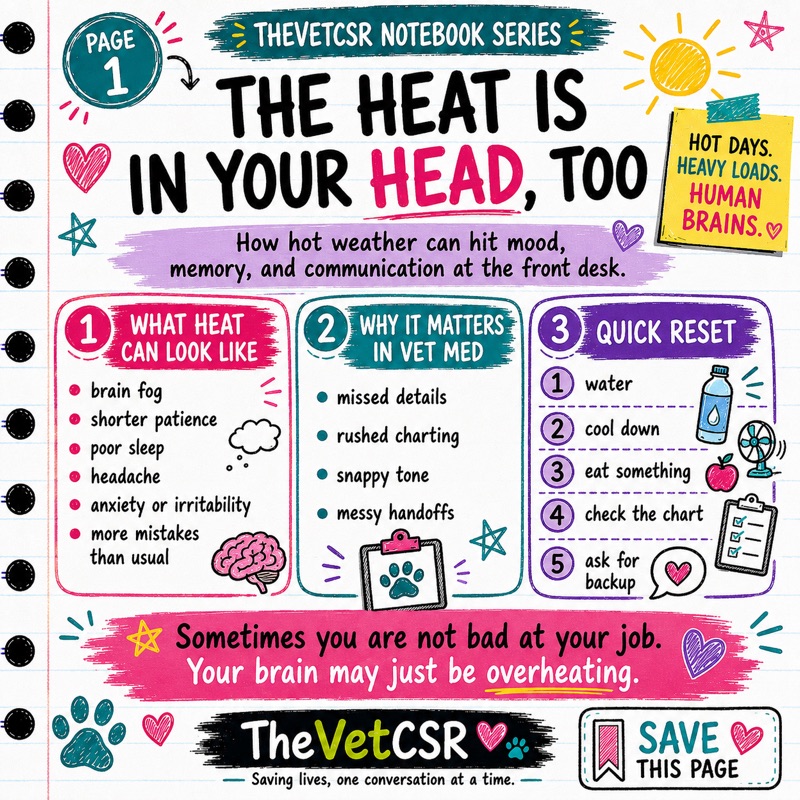
Hot weather does not just make people sweaty, tired, and irritated.
It can also affect sleep, mood, attention, memory, patience, and the way people communicate.
Which is a problem when your job requires you to answer five phones, remember three pet names, route a medical message, explain an estimate, check someone in, document a conversation, and remain calm while the lobby sounds like a kennel during a thunderstorm.
Sometimes you are not suddenly bad at your job.
Sometimes your brain is trying to work inside a body that is hot, dehydrated, sleep-deprived, and overstimulated.
Heat does not stop at the skin
Researchers have increasingly connected higher temperatures with worse mental-health outcomes, including psychological distress, increased demand for crisis support, and more acute mental-health presentations.
One study examined almost half a million telephone counseling calls in Germany. On days when the average temperature rose above 25°C, or 77°F, calls were 3.4% higher than on moderate-temperature days. Hot days were particularly associated with psychological distress and violence-related concerns. (arXiv)
That does not mean one warm afternoon automatically causes a mental-health crisis.
It means heat adds strain.
And strain matters when someone is already tired, anxious, overwhelmed, grieving, burnt out, taking certain medications, working without reliable cooling, or trying to function after several nights of poor sleep.
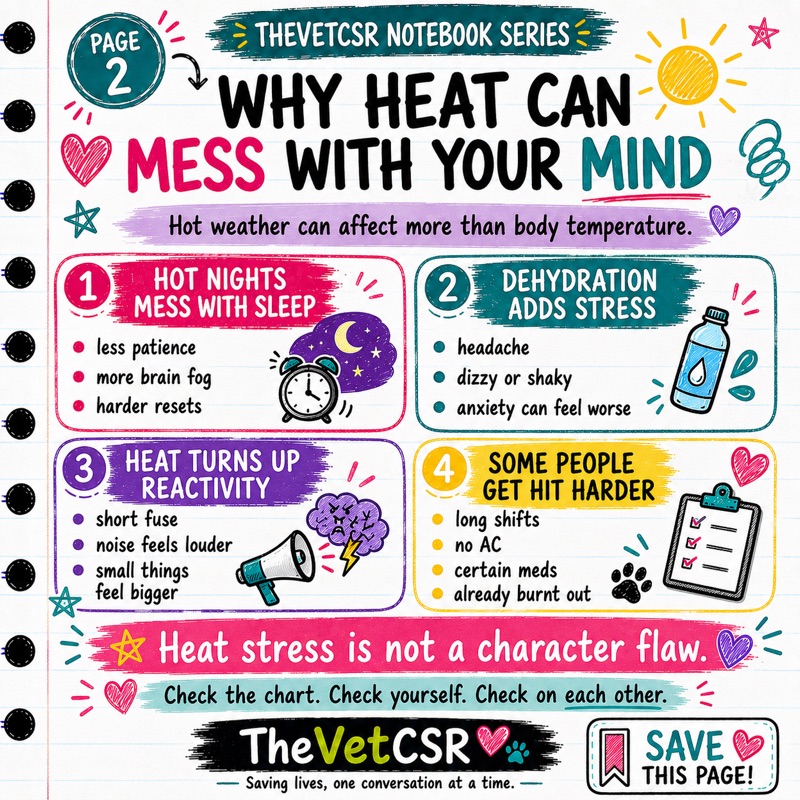
Hot nights can become hard days
The body normally cools during sleep.
When the bedroom stays hot, sleep can become lighter, shorter, and more disrupted. Poor sleep then affects attention, memory, emotional regulation, patience, and judgment the next day.
That is how a hot night can show up at the veterinary front desk as:
- rereading the same chart three times
- forgetting why a client is holding
- losing a pet’s name halfway through a sentence
- feeling unusually irritated by noise
- struggling to reset after a difficult call
- making ordinary tasks feel much harder than usual
The problem is not that the CSR stopped caring overnight.
The problem may be that the brain did not get the recovery time it needed.
Dehydration can feel like anxiety, anger, or brain fog
Heat increases sweating and physical strain. Even before someone reaches the point of severe heat illness, they may experience headache, fatigue, dizziness, difficulty concentrating, nausea, irritability, or weakness.
Those physical sensations can overlap with anxiety and emotional distress.
A racing heart, sweating, shakiness, dizziness, and difficulty focusing can feel like panic. A headache and exhaustion can shorten someone’s patience. A dehydrated brain may have a harder time holding onto details while phones, clients, coworkers, and animals all demand attention.
This does not excuse rude behavior or unsafe mistakes.
It explains why prevention matters before someone reaches the breaking point.
Heat can make an already loud job feel louder
Veterinary client service is sensory-heavy work.
Phones ring.
Dogs bark.
Clients interrupt.
Coworkers ask questions.
The printer jams.
A doctor needs a message.
Someone is crying.
Someone else is angry about an estimate.
On a normal day, the brain filters much of that input.
On a hot, exhausted, dehydrated day, the same environment may feel sharper, louder, and harder to manage.
A small interruption may feel enormous. A routine question may feel irritating. A difficult client may become harder to answer calmly.
That does not mean the CSR is weak.
It means the nervous system has less room left.
Some people may be affected more than others
Heat risk is not evenly distributed.
People may be more vulnerable when they:
- already live with anxiety, depression, PTSD, bipolar disorder, psychosis, substance-use concerns, or another mental-health condition
- work long shifts without dependable air conditioning
- are sleep-deprived
- have limited access to water or cooling
- are older, very young, pregnant, or chronically ill
- take medications that affect sweating, hydration, blood pressure, alertness, or temperature regulation
Certain medication classes can alter the body’s response to heat or increase dehydration risk. Nobody should stop or change a medication because of a social-media post; heat concerns should be discussed with a physician or pharmacist. (Verywell Health)
Why this matters in veterinary medicine
At the veterinary front desk, memory and communication are not minor workplace skills.
They affect patient care.
A foggy brain may forget to route a callback.
A rushed brain may document the wrong detail.
An overwhelmed brain may assume someone else handled the message.
A short-tempered brain may sound dismissive to a frightened client.
A tired brain may trust memory when it should check the chart.
That is why hot-day safety cannot stop at “drink more water.”
The team needs systems.
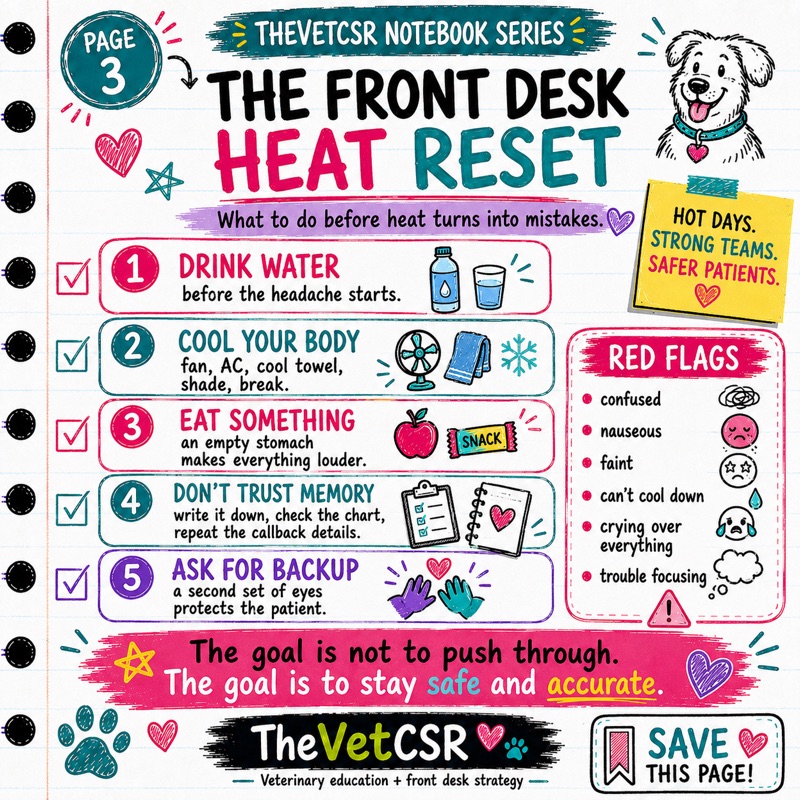
The Front Desk Heat Reset
When the heat starts affecting focus, mood, or communication:
1. Drink water before the headache starts
Do not wait until you feel terrible.
Keep water where staff can access it and make hydration part of the shift, not a reward after the work is finished.
2. Cool the body
Use air conditioning, a fan, shade, a cool towel, or a brief cooling break.
The goal is not comfort for comfort’s sake.
The goal is restoring safe function.
3. Eat something
An empty stomach, heat, and stress are a terrible communication team.
Even a small snack may help someone feel steadier and think more clearly.
4. Do not trust memory when the brain feels foggy
Write it down.
Check the chart.
Repeat the callback details.
Confirm the pet’s name.
Use the system instead of pretending the brain is functioning normally.
5. Ask for backup
A second set of eyes protects the patient.
Professionalism is not pretending to be fine.
Sometimes professionalism is saying:
“I’m getting foggy. Can you double-check this message before I send it?”
Know the difference between strain and an emergency
Heat-related confusion, fainting, inability to cool down, severe weakness, seizure, collapse, trouble breathing, or inability to wake someone can signal a medical emergency.
That is no longer a productivity problem.
That requires immediate medical help.
The real lesson
Heat stress is not a character flaw.
It is not laziness.
It is not proof that someone suddenly cannot handle veterinary medicine.
But it is also not something a team should ignore until mistakes happen.
The goal is not to push through at any cost.
The goal is to stay safe, accurate, and kind.
Check the chart.
Check yourself.
Check on each other.
Because client communication is patient care.
Documentation is patient safety.
And every conversation matters.
TheVetCSR
Saving lives, one conversation at a time.


No comments:
Post a Comment